
Oops! I’ve been criminalised in the UK while living in Japan
Hi, my name’s Chris, and I am criminal. I am a British national, I live in Japan yet I have committed a criminal offence under UK law — in my bedroom, right here in Japan. Yes, I confess: I expressed support online for Palestine Action. If you are a British national living anywhere outside the United Kingdom and have expressed support for Palestine Action online or by, say, wearing a t-shirt on the street in Roppongi, you are in exactly the same position. You may not know it. I certainly didn’t.
You what?
This week, London’s Metropolitan Police announced the resumption of its policy of arresting people for displaying placards expressing support for Palestine Action, the direct-action group that has targeted arms manufacturers and their facilities across the UK for supplying the Israeli military. The pause in arrests had been brief — a response to a significant High Court ruling that I’ll come to shortly — but it is over. Officers are back on the streets. People are once again being detained for holding up signs.
Who, exactly, is being arrested?
It is worth pausing on this. The arrests to date have not been confined to a fringe of hardcore activists — the kind of people power finds it convenient to dismiss. Among those detained have been elderly people, professionals, and members of the clergy. This is not a law being applied with surgical precision against a clearly defined threat. It is being applied broadly, to ordinary people who turned up in public places and held up a piece of card.
The absurdly long arm of the law
Palestine Action was proscribed under the Terrorism Act 2000 in July 2025. Proscription made it a criminal offence to be a member of the organisation, or to invite or — and note this word carefully — recklessly express support for it. Three aspects of this law deserve particular attention.
Online expression is explicitly covered. A post on Facebook, a graphic shared on Instagram, a statement on X or Bluesky: all of these fall within the scope of the legislation. Displaying a supportive image online, including a photograph taken in a private place, constitutes a public display under the Act. Your living room is a public space, legally speaking, the moment you point a camera at it and post the result.
Intention is not required. The offence can be committed recklessly. You do not need to have knowingly set out to support Palestine Action. Sharing someone else’s post, reposting a graphic, or expressing sympathy without any awareness of the legal position may be sufficient. Ignorance, in this instance, is not a defence.
And then there is the reach. This is the part that I suspect will surprise — or should surprise — many British nationals living abroad. The Counter-Terrorism and Border Security Act 2019 explicitly extended jurisdiction over these offences to UK nationals and residents wherever they happen to be in the world. This was not an oversight. Parliament debated it. Concerns were raised during that debate about precisely this kind of situation: British nationals in countries where Palestine Action is not proscribed, technically committing offences under UK law simply by speaking freely where they live. Those concerns were duly noted. The legislation passed anyway.
Being in Japan — or Australia, or Canada, or anywhere else — does not remove your legal liability. The offence travels with your passport.
You what? (reprised)
Here is where it gets, to any organised mind, extraordinary. In February 2026, the High Court found the proscription of Palestine Action to be unlawful. Not disproportionate; not poorly worded: unlawful.
The court simultaneously suspended the effect of its own ruling, pending a government appeal scheduled for 28 April 2026. In the interim, the proscription stands. The Met has confirmed it is enforcing it.
So: people are currently being arrested under a law a court has already ruled illegal. The arrests that prompted the Met’s brief pause — and the resumption of arrests announced this week — are all taking place in the shadow of a judgement that says the legal basis for those arrests should not exist. The government is appealing. Until that appeal is heard, the law stands and is being enforced.
No, really. That is where we are.
The lawmakers fall foul of the law
This has not gone unnoticed internationally. The UN Human Rights Chief has warned that the proscription appears to breach the United Kingdom’s obligations under international human rights law — specifically regarding freedom of expression, freedom of peaceful assembly, and freedom of association. The UK, which has long presented itself as a guardian of precisely these freedoms, might want to sit with that for a moment.
Ooops! (reprised)
I have already posted expressions of support for Palestine Action online. I did so without any awareness that I might be committing a criminal offence. I was not in the UK. It did not cross my mind that the reach of a domestic terrorism statute would extend to social media posts made from Japan.
I am not alone in this. Many British nationals — at home and abroad — will have shared posts, expressed sympathy, or displayed graphics without any knowledge of their legal exposure. The recklessness threshold in the legislation means that unknowing participation offers no safe harbour. You don’t need to have meant it. You just need to have done it.
But what can the buggers do?
To be concrete: if you are a British national living abroad and you have expressed support for Palestine Action online, you cannot be arrested where you are. Japan, Australia, Canada and most other countries will not extradite their residents to the UK on facts like these. But the offence is committed at the point of posting. On return to the UK — through an airport, at any point of entry — you could in principle face arrest and prosecution. Authorities can seek to have content removed from platforms. And the potential sentences are not trivial: a conviction for encouraging terrorism where no specific intent has been proven can carry between seven and nine years in custody.
The practical likelihood of prosecution for a single social media post is low. But low likelihood is not the same as no risk. The law’s breadth means the risk is there, whether or not it is routinely enforced. The chilling effect — the uncertainty, the calculation at the back of the mind — is, most likely, the point.
What you can still do
There is a distinction worth understanding clearly. Expressing support for Palestine Action may be a criminal offence. Writing about the law, criticising it, sharing information about it, pointing out that a court has already ruled it unlawful: none of that is. The space for public discourse about this legislation remains open, and it is a space worth occupying loudly.
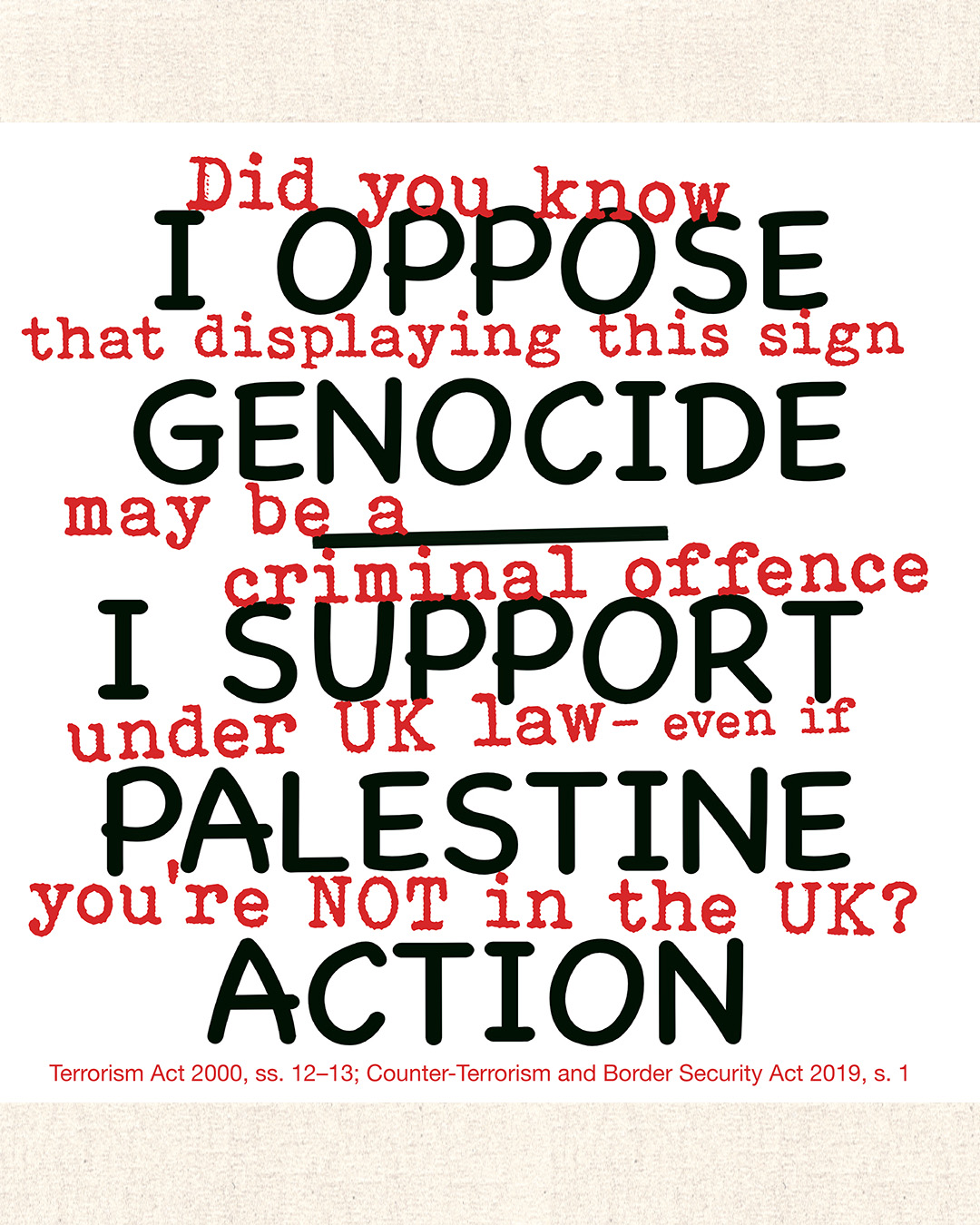
The graphic accompanying this post reproduces the sign that people are currently being arrested for displaying. It does so not to express support for Palestine Action, but to illustrate the legal consequences of displaying that sign — online, in public, or from the other side of the world. The purpose changes the character of the act. Informing people about a law is not the same as breaking it.
You know what to do.
A date for the diary
The appeal hearing is 28 April 2026. If the government loses, the proscription falls. The legal risk described above — for placard-holders, social media posters, and unknowing British nationals in Japan — evaporates. If the government wins, these questions become considerably more pressing.
Either way, what has already happened — the arrests, the scope of the law, the extraterritorial reach, the enforcement of a statute a court has called unlawful — is part of the record. It deserves to be part of the public conversation.


To be emailed whenever there’s a new post on this site, hit ‘Subscribe’ below. Subscribing doesn’t cost money and Psipook won’t ever share or sell your email address.
There is no comments feature on Psipook. This red button, cryptically labelled ‘contact’, is how you get in touch with us.

Discover more from psipook
Subscribe to get the latest posts sent to your email.