
An oil monopoly, a hydration break, an authoritarian regime or two, a sweary walrus, a murder — where’s our football gone?
I am old enough and quaint enough to remember when football was a sport for the people. Perhaps you can remember too, or at least know the story. So come on, let’s get dewy-eyed together as we recount over our pints, probably while wearing flat caps and trying to subdue the whippet or ferret or whatever mammal it is we are supposed to keep in our trouser pockets, how we used to kick a ball made of rags about in the street or on the old bomb sites spiny with unexploded bombs; how each pub used to have its own team, which were actually quite good after 12 pints of Old Peculiar, but shit before; how we used to go to games and stand for the entire game, in boots filled with Bovril to keep our feet warm. And we used to have proper teams with proper names like Chelsea and Leeds and not like Real Madrid or Bayern Munich, whatever the bloody hell a Bayern is.
Well, perhaps not quite like that, but Sport of the People, definitely. And in our minds it still is. It’s the most popular spectator sport in the world is played on every continent — yes, before you say ‘What about Antarctica?’, penguins play football too — it can be played in streets or stadiums and can be talked about at tedious length in any language. And it was definitely a rite of passage in the game, after hefting the ball over the hedge, to have to go up the Scary Neighbour’s House and ask ‘Please, sir, can we have our football back?’
And the World Cup used to be a real occasion where your national team could show off how you did it in your country, and how that was inevitably better than how everyone else did it, a thesis not altered or adjusted by the fact of losing more often than winning.
But then one day, the World Cup was no longer the World Cup: it was the FIFA World Cup™ — you have to pronounce the ™ or they get the lawyers on you.
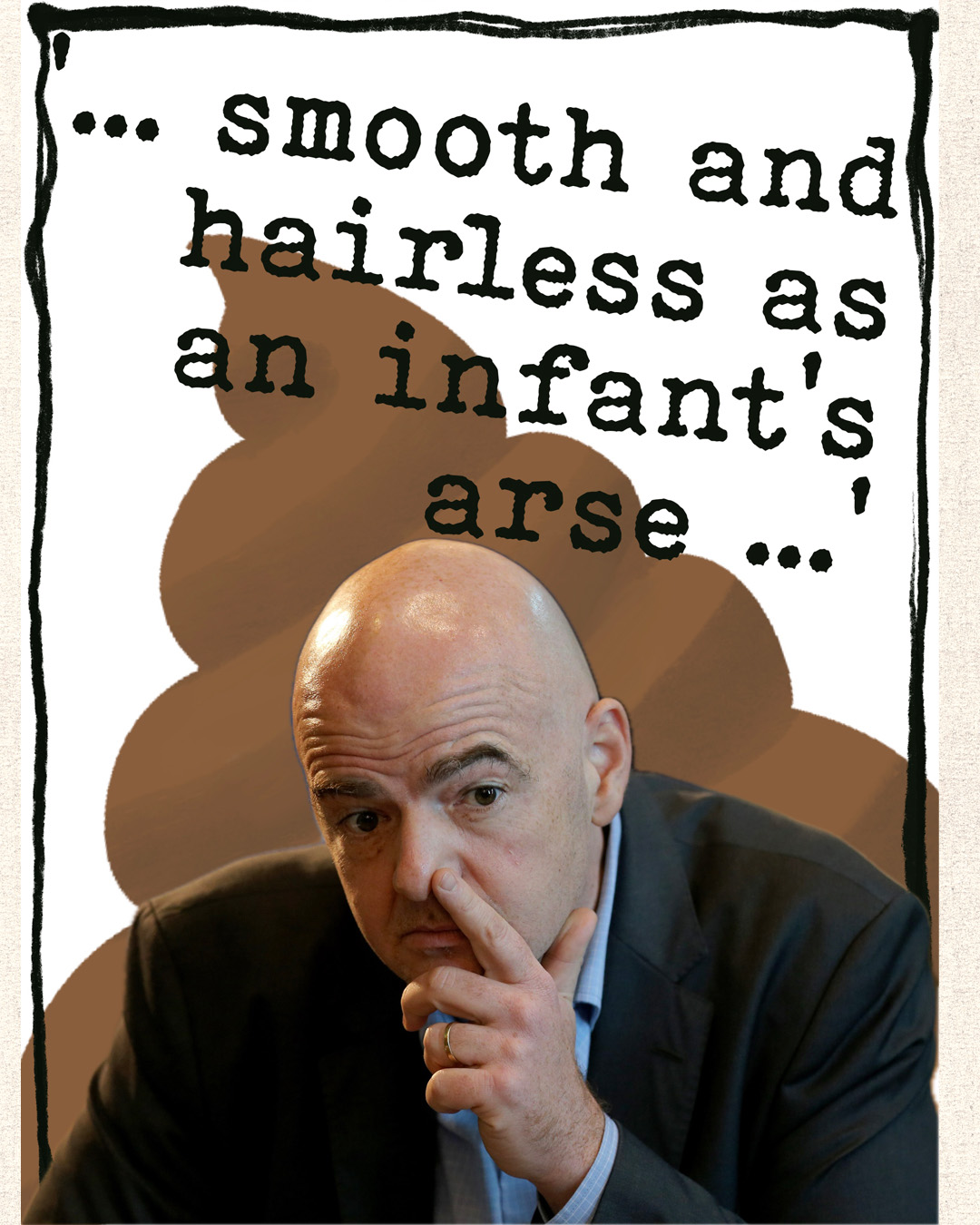
Ticket prices are equivalent to a year’s salary, and the events are held in countries that are carefully selected as the most corrupt and most venal places on the planet (Sorry, Canada and Mexico, but just look who your current co-host is! It’s like Lady Di and Nelson Mandela working with Al Capone; they may be Lady Di and Nelson Mandela but they are still working with Al Capone.) Before the current event, the Qatar iteration of the FIFA World Cup™ came with considerable human and environmental cost, as whole deserts were drained of sand and filled with the blood and corpses of contract workers from less affluent countries. Later, certain FIFA officials were experiencing some inconvenient legal attention over allegations of corruption, but when Gianni Infantino, FIFA supremo — so named because his head is as smooth and hairless as an infant’s arse and just as full of shit — invented the FIFA peace prize for Donald Trump, those investigations mysteriously disappeared.
Corruption aside, the competition now seems less about footballing skills and more about who can shower FIFA World Cup™ with the most advertising dosh. The stadiums and streaming apps are kaleidoscopes of advertising. You are trying to focus on the long swinging pass from the left when you are distracted by a huge purple ogre peering out of the perimeter boards, from between the words ‘McDonald’s’ and ‘just look into the spinning light and relax’.
FIFA has invented this hydration break (boooooooooooo!) simply because American media companies demanded the extra ad time. I am also old enough to remember FIFA’s attempt to establish the sport in the US in the 1980s: there again, the media companies demanded the sport be structured in quarters like basketball and that FIFA increase the physical size of the goal so there would be scores high enough to please the infantilised psyche of the average US advertising audience, I mean sports fan. That was a long time ago when FIFA had some residual respect for itself, and the American version of the sport had to go the harder, longer route of getting used to eating something foreign and not quite to its taste. The hydration break — listen to this dinosaur here if you know what’s good for you — is the same bollocks by another name.
Advertising. Streaming. Having resolved to not bother with the World Cup this time around for all the obvious reasons, I anyway capitulated before day one by signing up to a special streaming deal that offered all the games live and available to watch later at my leisure. The service is offered in Japan by DMM and DAZN, and will cost me — sorry, I just had a call from a lawyer: that should be DMMxDAZN™ — and will cost me ¥7,000 for two months — a reasonably nice meal for two or 10.5 litres of my preferred brand of Tempranillo. Now I put it in such stark terms, I think I should have just bought the Tempranillo and stayed oblivious for the duration. On DAZN, each match in the group stage was preceded by 15 to 20 minutes of advertisements and, I am now discovering, by 30 to 60 minutes in the round of 32 stage. This includes advertisements for FIFA and DMMxDAZN, whose products I am already using, and all the stadium advertising, and mini blip adverts during the game for Visa and Lenovo: I am actually paying to watch advertisements.
One of the advertisements is a FIFA brand-vert full of catchy tunes, colour, movement, adorable dancing children — about the importance of exercise for kids, and this message is sandwiched between ads for McDonald’s and Coca Cola: surely Mammon lapping at its own puddle of vomit.
But none of this — the ad breaks, the hydration timeout, the purple ogre — is really about advertising at all. It’s what monopoly looks like from the inside, when you’re the one holding the remote. The sheer bloody-minded quantity of it is the tell. This isn’t a sponsor buying some airtime; it’s a small number of companies buying total, uncontested access to your eyeballs, your data, and, as it turns out, quite a lot of the actual law in whichever country happens to be hosting.
Because FIFA does not just put on an international sporting tournament with a carefully managed trademark on their letterhead. They ensure that their paying corporate sponsors and advertisers hold an absolute monopoly, and to do this they demand total commercial jurisdiction over the physical and digital space of the host nations. If you want a cola other than official Coca-Cola or a beer other than Budweiser (or whatever their partner beer), even outside the stadium, you can’t have one — every vendor within the ‘FIFA commercial zone’ is forbidden from selling brands that rival FIFA partner products, whether or not those businesses have anything to do with FIFA or the World Cup. Try serving a ‘World Cup Coffee’ round the corner from the stadium and you’ll find out how fast the lawyers move. And here’s the part that should actually alarm you: these rules, under the terms of the hosting agreement between FIFA and the host nation, are enforced by the local police and judiciary, at local taxpayers’ expense. A private Swiss corporation writes the statute; your government’s police force enforces it; you pay for the privilege. These laws even have a name — World Cup Laws — as if that made them any less extraordinary. A corporation gets to legislate in a sovereign country, as an actual condition of being allowed to stage a football tournament there, and the host nation signs up for it gladly, because the alternative is not getting to host the party at all. Never mind the local café owner standing next to the stadium who becomes collateral damage in a trademark dispute he didn’t know he was part of.
So far so much corporate shit, but stay with me: it’s about to get a great deal darker, because there’s a murder involved.
FIFA doesn’t just have advertisers or sponsors any longer, they have ‘partners’, and this term is not just aggravating marketing talk — it points at a model more properly, and more aggravatingly, called corporate symbiosis. FIFA doesn’t just buy VAR gear, they have an ‘Official VAR Review TV Provider’ for the FIFA World Cup 2026™ (whose name I’m gleefully not providing here, partly out of spite, but mostly out of spite). Partner Lenovo (aka Motorola) doesn’t just provide the clocks on our screens and in the stadium — they are FIFA’s ‘Official Technology Partner’ and provide the entire technological infrastructure of the games across North America. That involved deploying 17,000 ‘corporate devices’ (including Motorola laptops and smartphones), a team of hundreds of engineers to staff FIFA’s ‘Technology Command Centre’ in Miami and its ‘International Broadcast Centre’ in Dallas, and all tournament operations. Lenovo provides the server hardware and data-centre processing power for the massive quantity of video, the technology to keep stadium broadcast delays to less than five seconds, the AI-stabilised head-mounted referee cams for the global audience, and the on-pitch 3D scanning that creates ‘lifelike’ digital avatars for all 1,248 players, which feed into the ‘Semi-Automated Offside Technology’ used by VAR. They also developed ‘Football AI Pro’, a generative AI analysis tool given to every competing team to process match data and generate tactical insights.
Meanwhile, Lenovo gets a premium global stage on which to prove to enterprise clients that its AI and data-centre infrastructure can run the authoritarian, corporate dystopia they are collectively establishing.
Fucking hell, as the Walrus said.
And that’s just one partner of 21, who collectively provide everything from which profit can be extracted — from the tech backbone to places to stay (Airbnb).
Now, a different kind of partner.
Aramco. Aramco’s name is another that features on the digital ad boards. What’s an Aramco, I thought? Do I need one for the garden? I had to look it up. Aramco is — I’m sure I’m the last person on the planet to realise — the Saudi Arabian state oil company. It’s not too much of a stretch to say that Aramco is the Saudi state, and the Saudi state isAramco.
Aramco is the ‘Official Energy Partner’, a top-tier, Sovereign partner with the same status as Lenovo. Environmental organisations will point out that Aramco is one of the largest corporate contributors to global greenhouse gas emissions and that, even as it energetically waves its green flag, it is expanding its massive production capacity.
But here’s the thing worth sitting with for a second: unlike Lenovo, Aramco doesn’t actually do anything. While Lenovo builds the tech infrastructure the tournament runs on, Aramco doesn’t physically fuel the stadiums, power the floodlights, or provide the electricity for the FIFA World Cup™. It doesn’t lay pipelines to the venues or park oil tankers in the host cities. It has offered some data-analytics services and set up a few branded spaces in stadiums and online, but that’s a publicly acceptable fig leaf for the handover of $100 million a year, every year, for four years. Aramco pays the cash, and FIFA gives them a creative vocabulary — ‘energy’, ‘power’, ‘fluidity’ — to make an oil monopoly look like a modern, tech-driven lifestyle brand.
It’s not just football, either. Aramco is pouring billions into global sports sponsorship — Formula 1, cricket, major golf tournaments. Critics argue the Saudi government uses Aramco’s wealth to launder its global image and distract from its domestic human rights record. It was, in fact, the international fallout from the murder of journalist Jamal Khashoggi — dismembered, his remains never found — that pushed the Saudi government toward ‘sportswashing’ as the detergent of choice for that particular stain.
And FIFA, custodian of The People’s Sport™, has now granted the Saudi state something close to the ultimate absolution.
The alert reader (hi!) will already know where this is going: the host of the 2034 FIFA World Cup™ is Saudi Arabia.
How did that happen? Behind closed doors, apparently, when FIFA quietly changed its own tendering rules so that Saudi Arabia’s bid was the only bid.
Funny that.
Ha ha.
It sits very comfortably, this arrangement, alongside FIFA’s green and ethical claims — which are, it turns out, a pile of bollocks too, and have been for some time: this is, after all, the organisation that gave us the 2015 corruption scandal, some $200 million in alleged kickbacks and bribes, and a small parade of indicted officials. The current FIFA World Cup™ has roughly twice the carbon footprint of the Qatar tournament, and FIFA is currently in a spot of bother with the Swiss Fairness Commission — a kind of advertising standards body — for having claimed the last World Cup was carbon neutral when it plainly wasn’t. This tournament, spread across three enormous countries, has already been criticised for the sheer volume of air travel it demands of fans and teams alike. The 2030 World Cup will be held across six countries on three continents.
The media still likes to call FIFA ‘football’s governing body’. It isn’t. It’s a private corporation that has captured the People’s Sport and is extracting from it everything it can.
So back to the ferrets and the whippets: Please, sir, can we have our football back?
No, apparently not, the scary neighbour has eaten it.
This article first appeared on Chris Page’s Psipook Substack
To be emailed whenever there’s a new post on this site, hit ‘Subscribe’ below. Subscribing doesn’t cost money and Psipook won’t ever share or sell your email address.
There is no comments feature on Psipook. This red button, cryptically labelled ‘contact’, is how you get in touch with us.
Discover more from psipook
Subscribe to get the latest posts sent to your email.